Date: 2026-05-29 Visitcount: 10
On 27 May 2026, the Second International Symposium on John Dewey and World Education was convened at Teachers College, Columbia University, United States. Under the theme“Rethinking Education in the Age of AI: Continuity, Innovation, and Challenges,”the symposium brought together leading scholars, experts, and practitioners from China and the United States to examine the contemporary relevance of John Dewey’s educational thought in the context of rapid technological transformation. Discussions focused on how education systems can respond to emerging global challenges while balancing continuity and innovation, and on identifying pathways for future-oriented educational reform.
Professor Xiaozhou Xu, UNESCO Chairholder in Entrepreneurial Education at Zhejiang University and Director of the Institute of Education Modernization at Zhejiang University, was invited to participate in the symposium and addressed the conference with a presentation entitled “John Dewey and Educational Modernization in China.”
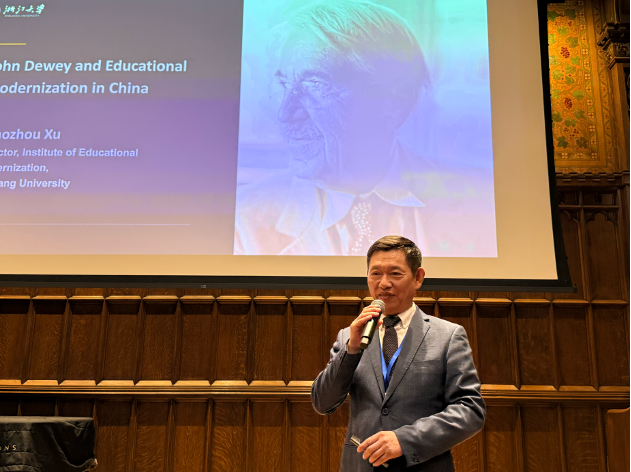
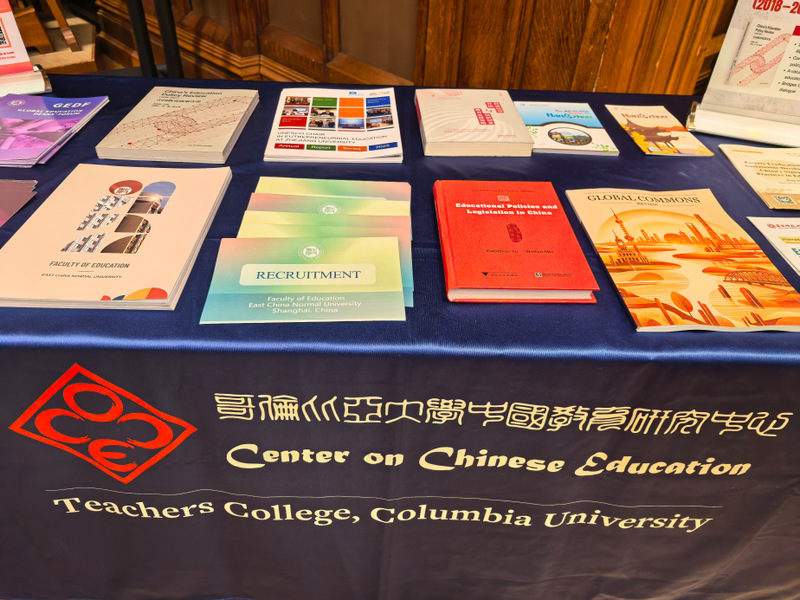
In his address, Professor Xu explored three interrelated themes. First, he traced the intellectual connections between John Dewey and the Zhejiang University school of education, highlighting Dewey’s enduring influence on educational theory and practice in China. This influence is reflected in five key dimensions: the integration of theory and practice, a commitment to social improvement, the development of student agency, the advancement of educational internationalization, and the promotion of innovation in education.
Second, Professor Xu examined the convergence between the core principles of Dewey’s educational philosophy and China’s approach to educational modernization. He noted that educational development unfolds within a dynamic interplay between continuity and change. In the age of artificial intelligence, education faces the dual challenge of adapting to evolving societal needs while supporting the holistic development of individuals. He emphasized that educational modernization in this context requires integrating global commonalities with national characteristics, as well as scientific rationality with humanistic values, in order to build a modern educational philosophy and institutional framework with distinctive features.
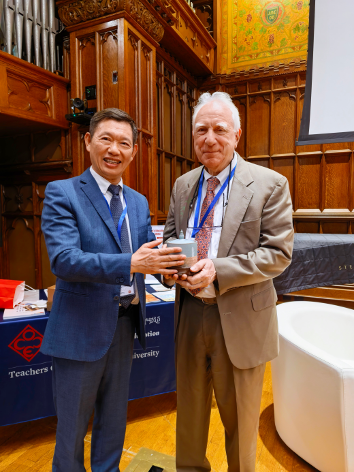
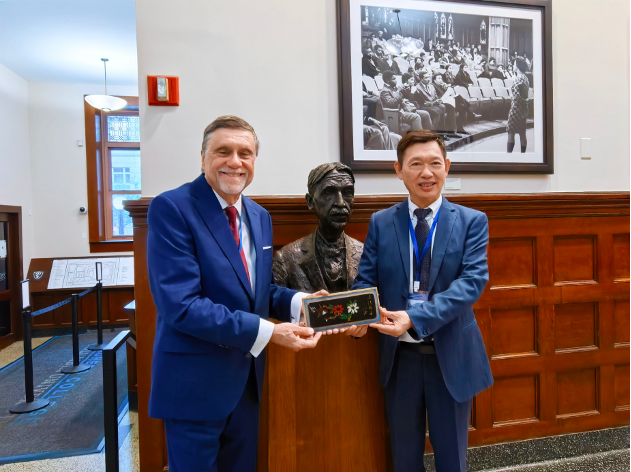
During the symposium, Professor Xu presented Chinese intangible cultural heritage souvenirs to Dr. Hervé Varenne, Acting Director of the China Education Research Center at Teachers College, Columbia University, and to Dr. John Allegrante, as a gesture of academic exchange and cultural dialogue.
Finally, drawing on John Dewey’s 1921 lecture—“The old is not necessarily entirely wrong, and the new is not necessarily entirely right”—Professor Xu highlighted the emerging challenges of educational entrepreneurship in a global context. He underscored the need for modern universities to balance inheritance and innovation in fulfilling their contemporary missions, and to work collaboratively in advancing educational modernization worldwide, contributing to shared human progress and the development of civilization.
During his visit to New York, Professor Xu also engaged in discussions with international experts on strengthening cooperation in entrepreneurship education and the internationalization of education. The exchanges led to preliminary understandings on collaboration in talent development, joint research initiatives, and the organization of international conferences.

 College of Education, Zhejiang University
 Tel : +86 571 88273934
 Fax : +86 571 88273187