Date: 2025-11-27 Visitcount: 10
As technology and culture become increasingly intertwined in today’s interconnected world, the ability to navigate both spheres with confidence has become indispensable. Understanding how artificial intelligence (AI) can advance IT literacy, intercultural awareness, and communicative competence is now a key component of global education.
The project “(AI for Education: Fostering Cross-Cultural Competence and IT Literacy Through Global Learning Innovations”- led by Professor Rustam Shadiev of the College of Education, Zhejiang University, with the assistance of his doctoral student Mr. SHI Gaojun - addresses this educational need by empowering students with critical 21st-century skills. The initiative integrates AI-based learning within a cross-cultural framework to enhance technological proficiency, deepen cultural understanding, and strengthen communication across diverse contexts. Students could not only explore how AI functions in different societies but also reflect on its ethical, social, and cultural implications.
As part of this initiative, the “AI in Education” course hosted a series of Global Expert Lectures delivered by distinguished international scholars. Each lecture offered students a unique opportunity to engage with global perspectives on AI and its transformative impact on education and society.
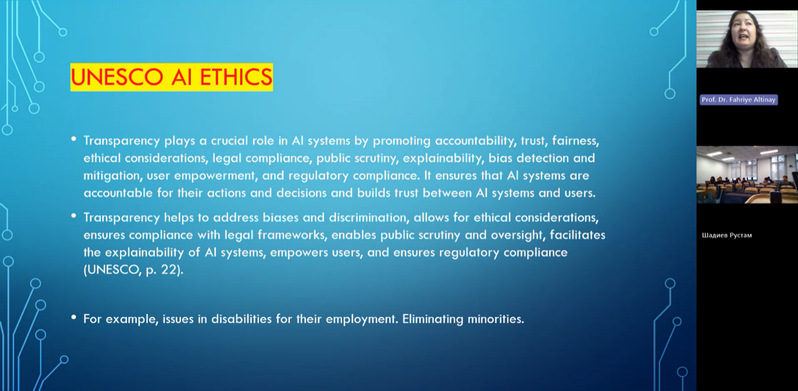
The first lecture titled Ethics and Social Implications of AI in Education was carried out on October 21, 2025 by Prof. Dr. Fahriye Altınay, Faculty of Education, Near East University, Northern Cyprus. Professor Altınay explored the ethical, cultural, and societal implications of AI in education. She discussed how cultural values and social awareness influence ethical decision-making and educational practice, emphasizing inclusivity, global citizenship, and respect for diversity. The lecture underscored the importance of a human-centered approach to AI, grounded in transparency, fairness, and equality, and connected the responsible use of AI to the United Nations Sustainable Development Goals, particularly inclusive and equitable quality education for all.
Professor Altınay’s lecture broadened students’ ethical awareness and deepened their understanding of the responsibilities involved in applying AI to educational contexts. By emphasizing human-centered design and moral accountability, her insights encouraged students to view AI not merely as a technological tool but as a catalyst for social inclusion and cultural understanding. The session inspired participants to pursue innovation while maintaining ethical integrity and global responsibility.
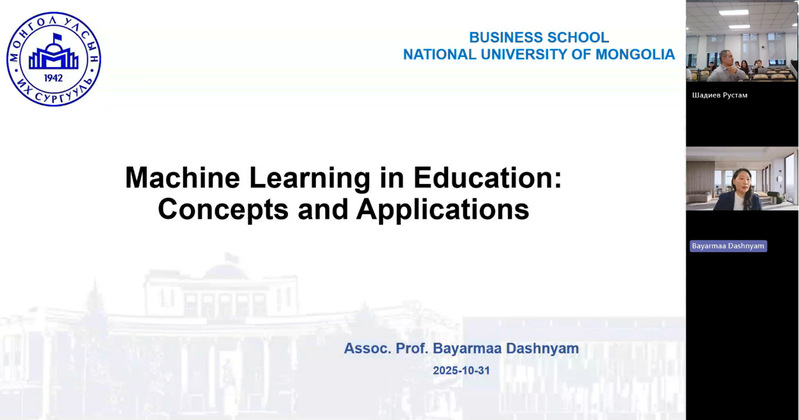
The second lecture, entitled Machine Learning, and scheduled for October 31, 2025, was delivered by Dr. Bayarmaa Dashnyam, Associate Professor, Business School, National University of Mongolia. Dr. Dashnyam provided a comprehensive introduction to machine learning, explaining how computers learn from data and identifying key distinctions between traditional programming and data-driven models. The lecture covered supervised, unsupervised, and reinforcement learning, as well as data preparation, model training, and performance evaluation. She highlighted real-world educational applications of machine learning, including predictive analytics, personalized learning, and automation of assessment and administrative tasks. Through Dr. Dashnyam’s lecture, students gained practical insights into how machine learning enhances educational efficiency and personalization. They learned how data analytics can help educators identify learning needs, improve outcomes, and provide targeted support. The discussion demonstrated the power of intelligent systems in creating adaptive, student-centered learning environments that foster academic success and institutional innovation.
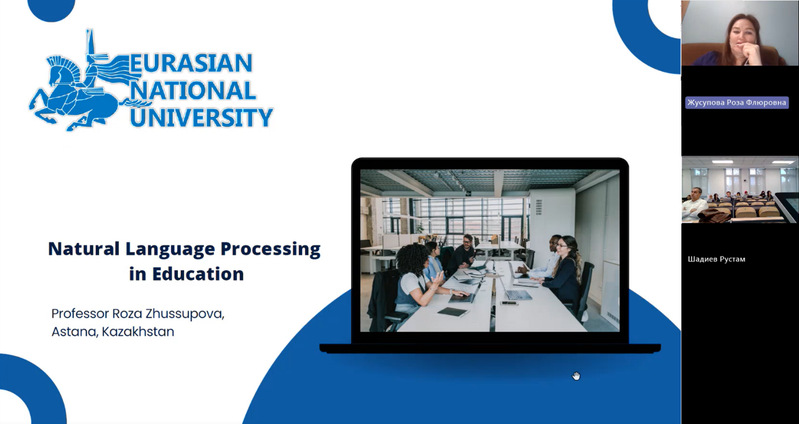
The third lecture, Natural Language Processing in Education, was held on November 4, 2025 by Prof. Dr. Roza Zhussupova, Graduate School of Education, L.N. Gumilyov Eurasian National University, Kazakhstan.Professor Zhussupova examined the role of Natural Language Processing (NLP) in language learning and intercultural education. She discussed AI-powered tools such as Grammarly, Duolingo, and ChatGPT, focusing on their use in providing automated corrective feedback and enhancing language proficiency. She also presented collaborative projects between Chinese and Kazakhstani universities, where students employed AI-based feedback systems and 360-degree virtual-reality videos for intercultural exchange. These activities improved participants’ linguistic competence, digital literacy, and cross-cultural understanding. The lecture vividly demonstrated how NLP technologies can transform language learning through interactive and culturally responsive AI applications. Students learned how AI facilitates meaningful global communication and fosters intercultural empathy. By integrating generative and multimodal AI tools, learners experienced firsthand how technology can bridge linguistic and cultural divides, enriching education on a global scale.
Each session, held via Microsoft Teams, provided an immersive and interactive learning experience that connected theoretical knowledge with real-world perspectives on AI, ethics, and culture.
In addition, students participated in a cross-cultural exchange with peers from Northern Cyprus and Kazakhstan, creating multimodal AI-generated content to share their cultural identities and educational insights. Through this collaboration, students from explored diverse AI applications and gained a deeper appreciation of global learning environments.
This successful lecture series and exchange initiative reflects the College of Education’s commitment to innovation, collaboration, and excellence in AI-enhanced education - preparing students to thrive in a technologically advanced and culturally interconnected world.

 College of Education, Zhejiang University
 Tel : +86 571 88273934
 Fax : +86 571 88273187